
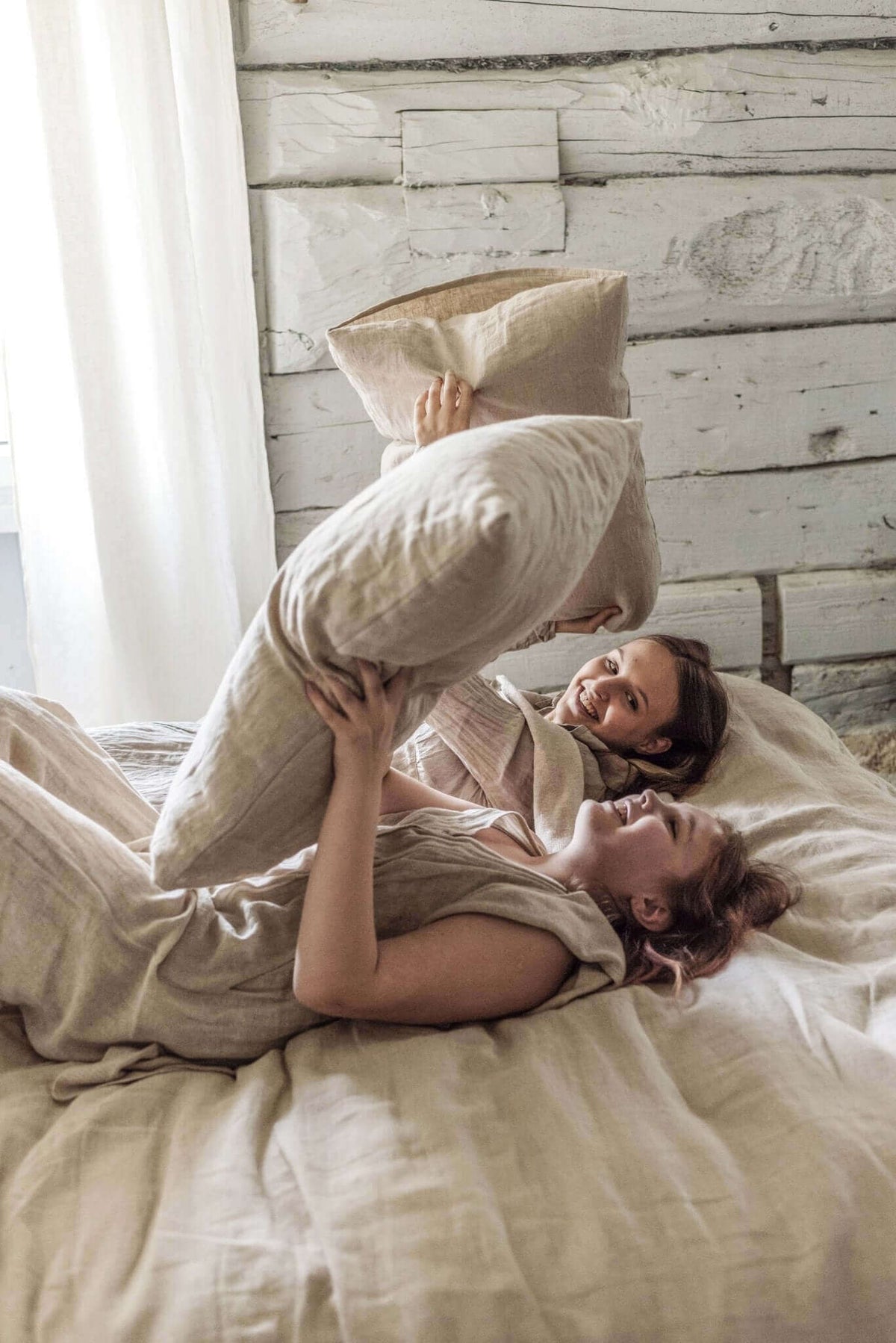
Parents usually think more carefully about the materials they bring into a child’s room.
That makes sense.
Bedding, curtains, blankets and other textiles are part of everyday life. They are touched, washed, slept in and lived with for years.
Linen is often chosen for children’s rooms because it is breathable, absorbent and comfortable in different seasons.
But I would not describe it as automatically “the safest” or “the best” fabric for every child.
I think it is more useful to understand what linen actually does well, and what to check before choosing it.
Linen is breathable
One of linen’s most useful qualities is airflow.
The structure of the fibre and weave allows air to move through the fabric, which is one reason linen is widely used for bedding and lightweight home textiles.
In a child’s bedroom, this can make linen feel comfortable for bedding, pillowcases and lightweight covers.
It is especially useful when the goal is a fabric that does not feel heavy or overly insulating.
Linen handles moisture well
Linen absorbs moisture efficiently and can release it relatively quickly.
That matters for bedding because bedrooms can become warm during the night, especially in summer.
A fabric that manages moisture well can feel more comfortable when used close to the body.
That said, moisture management should not be confused with medical claims.
Linen does not treat allergies, improve circulation or prevent illness.
It is simply a natural fibre with practical textile properties.
Fabric certification matters more than vague “natural” claims
I increasingly prefer specific information over words like “natural” or “healthy”.
At DUSTY LINEN, the linen we use is softened European linen that meets OEKO-TEX STANDARD 100 requirements.
That means the certified textile has been tested against the standard’s limits for harmful substances.
For parents, this is much more useful information than simply saying that linen is “safe because it is natural”.
If you want to see and feel the actual fabric before choosing bedding or curtains, our linen fabric samples make it possible to compare colour, texture and fabric weight at home.
Linen can work well for bedding
For bedding, comfort usually comes down to several things:
- breathability
- moisture management
- fabric weight
- softness
- how the textile feels after washing
Our linen bedding is made from softened linen so the fabric does not begin with the very stiff feel people sometimes associate with new linen.
Over time, linen generally becomes softer with washing and use.
That gradual change is one of the reasons many people enjoy living with it.
Curtains need a different kind of thinking
Curtains in a child’s room have a different job.
Here, the questions are usually about light, privacy and sleep.
A lightweight linen curtain can soften daylight and create privacy, but linen alone is not blackout fabric.
If stronger room darkening is needed, a lining or layered construction is the more realistic solution.
Our custom linen curtains can be made in different linen weights and, where needed, with a separate dimout lining.
The important thing is to choose based on what the room actually needs, rather than assuming one fabric can do everything.
Fabric weight matters
A 175 g/m² linen and a 190 g/m² linen do not behave exactly the same way.
The lighter option is more semi-sheer and relaxed.
The denser linen has more visual weight and structure.
In a child’s room, the right choice depends on whether you care more about:
- daylight
- privacy
- softness
- room darkening
- drape
This is why I recommend choosing fabric based on the actual room, not just the colour.
Linen is easy to live with, but it still needs normal care
Linen can be washed and used regularly, which makes it practical for family homes.
But like any natural textile, it changes with use.
It may wrinkle.
It may soften.
Strong sunlight can gradually affect the colour.
Different weights may shrink slightly after repeated washing.
None of that makes it unsuitable.
It simply means that linen behaves like a natural fibre rather than a perfectly uniform synthetic textile.
So, is linen a good choice for a child’s room?
It can be.
Linen is breathable, moisture-absorbing, washable and available in very different weights and constructions.
But I would not choose it because someone says it is “the healthiest” or “the safest”.
I would choose it because its practical properties suit the room and the way the family wants to use it.
And if colour, transparency or fabric weight matters, I would always look at the actual linen first.
For me, that is the more useful way to choose.
Rita


