
Linen has been part of everyday human life for thousands of years.
It is one of the oldest textile fibres still widely used today. Archaeological evidence shows that flax was used for textile production thousands of years before the modern textile industry existed, and linen became important across ancient Europe, the Mediterranean and Egypt. Flax also has a particularly long history in Lithuania, where its cultivation is documented as reaching back roughly 4,000 years.
That history interests me, but not because something old is automatically better.
What interests me is that linen has remained useful.
People kept growing flax, spinning it, weaving it and bringing it into their homes because the material did something practical.
And many of those qualities still matter now.
Linen was part of everyday life long before it became a luxury fabric
Today linen is often associated with expensive bedding, summer clothing or carefully styled interiors.
Historically, however, it was much more ordinary than that.
In Lithuania, flax was closely connected with domestic life. Linen was used for clothing, bedding, towels, table textiles and household fabrics, and the process of growing and preparing flax was part of rural life for generations.
That is quite different from the way linen is sometimes marketed today.
It was not simply something decorative.
It had to work.
It had to be washable, useful, strong enough for repeated use and adaptable to very different purposes.
I think that practical history explains a lot about why linen still makes sense in a modern home.
The fibre itself has useful properties
Linen is made from flax.
The fibre is known for strength, absorbency and its ability to conduct heat, which is one reason linen has historically been used in warmer climates as well as for household textiles. The Victoria and Albert Museum notes that linen’s ability to absorb water and conduct heat contributed to its use in clothing and domestic textiles over centuries.
In everyday use, that means linen can feel very different from many synthetic fabrics.
It breathes.
It absorbs moisture.
It dries relatively efficiently.
And depending on the weave and weight, it can be made into anything from a light semi-sheer textile to something much denser and more structured.
That versatility is one of the reasons I still enjoy working with it.
Linen in the bedroom
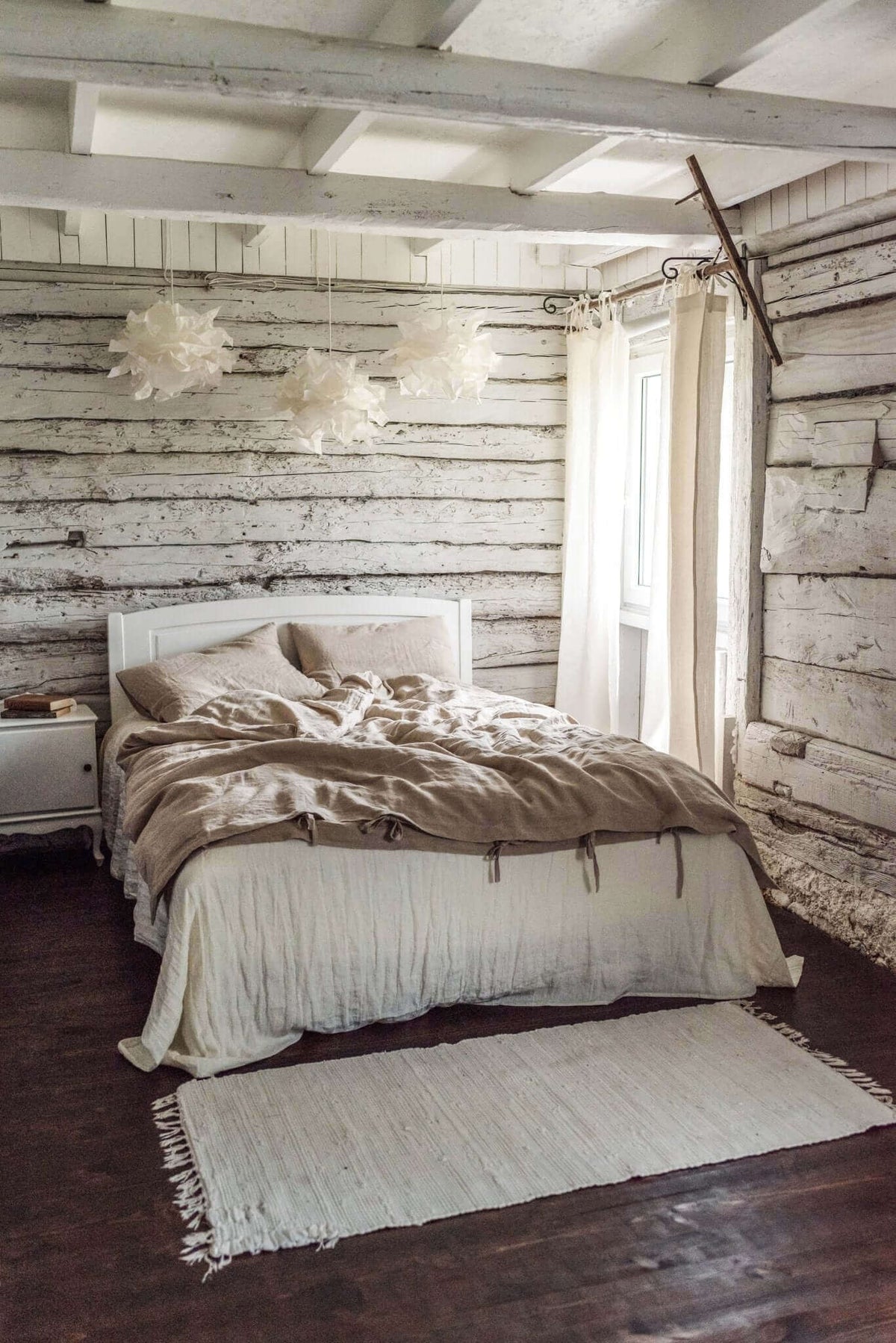
Bedding is probably one of the places where people understand linen most easily.
The fabric is breathable and good at managing moisture, which is useful in something that remains in close contact with the body for hours at a time.
But I also think there is another reason people like linen bedding.
It changes with use.
It becomes softer.
It develops a more relaxed surface.
It does not need to remain perfectly pressed in order to look right.
That is part of why our linen bedding is pre-washed before it reaches the customer. The aim is not to make the fabric look untouched. It is to let it already feel like something that belongs in daily life. Dusty Linen
Linen curtains are a very different use of the same fibre
Curtains ask something completely different from fabric.
Here the important questions are usually:
How much light should pass through?
How much privacy do you need?
How much structure should the curtain have?
How do you want it to fall?
The same natural fibre can behave very differently depending on its weight and construction.
At DUSTY LINEN, our custom linen curtains are made to order because the proportions of the room matter just as much as the fabric itself.
A 175 g/m² linen panel can feel light and relaxed.
A denser 190 g/m² linen has more weight and visual presence.
And when greater room darkening is needed, the answer is not to pretend that linen itself is blackout. We add a separate lining or layered construction.
That distinction matters to me.
Linen has limits too
One reason I appreciate linen more now is that I understand its limitations better.
It moves with humidity.
It wrinkles.
Strong sunlight will affect it over time.
Different batches can vary slightly.
And it will never behave exactly like a highly engineered synthetic textile.
A few years ago, I might have tried harder to present all of those things as advantages.
Now I think it is more useful simply to explain them.
Some people love the movement and variation.
Some do not.
Both are reasonable.
A material should fit the way someone actually wants to live with it.
Linen in bathrooms and kitchens
Historically, linen has also been widely used for household textiles because of its absorbency and ability to dry comparatively well.
That still makes sense for products such as towels, kitchen cloths and table textiles.
But again, the construction matters.
A decorative linen shower curtain, for example, is not automatically waterproof simply because linen handles moisture well.
For bathrooms, we use linen together with a separate waterproof layer where necessary. You can see this approach in our linen shower curtains.
The same principle applies across the rest of the home.
The fabric has qualities.
The job is to use those qualities properly rather than expect one material to solve every problem by itself.
Why linen still matters to me
The history of linen is interesting because it shows how long people have found uses for this fibre.
But history alone is not why I work with it.
I work with linen because it remains practical.
It can be soft or structured.
Light or dense.
Used close to the skin or hanging several metres high at a window.
It ages visibly.
It asks for a little tolerance.
And it works best when you understand what it is rather than expect it to imitate another fabric.
That is probably what I value most now.
Not the idea that linen is somehow perfect.
The fact that after thousands of years, it is still useful.
Rita


