

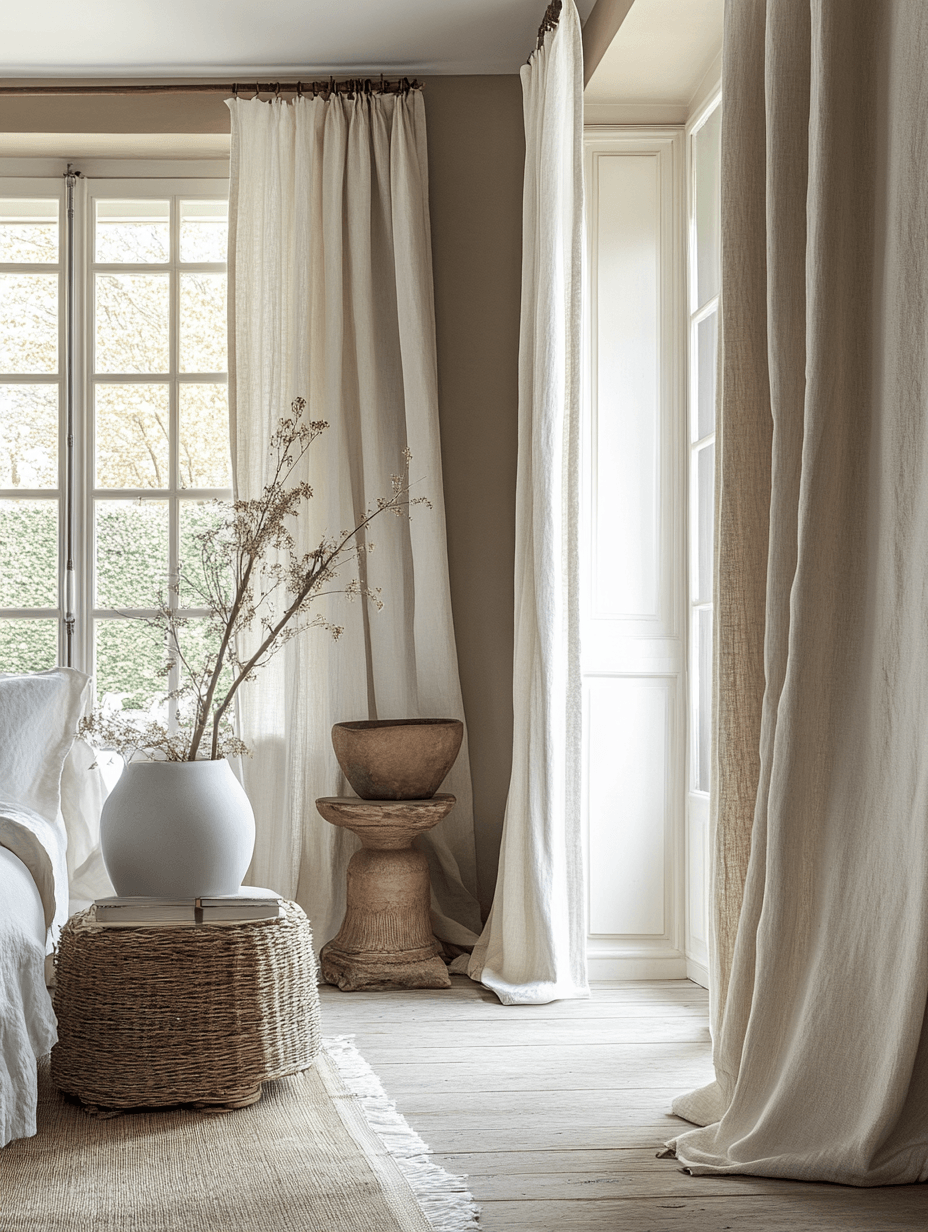
Custom linen curtains are a thoughtful choice when standard curtain sizes do not suit your windows, your ceiling height, or the way you want your room to feel. They allow you to choose the fabric, width, length, top finish and overall look with much more intention than ready-made curtains.
They are especially useful when you want a specific linen texture, a soft natural drape, a more refined fit, or a curtain that works with non-standard windows. At Dusty Linen, many curtain orders are made individually, which means we can often adapt the size, fabric type and hanging style to the room rather than asking the room to fit a standard product.
One important detail is that Dusty Linen works with a wide linen fabric collection. In many cases, this allows us to make linen curtains without visible fabric joins. Depending on the fabric, curtain size and construction, we can often create seamless curtain panels up to approximately 250 cm in height across very wide widths, or panels up to approximately 280 cm wide in almost any height. Very large or unusual curtain orders are always assessed individually, and we confirm the sewing possibilities before production.
This guide will help you understand the main decisions before ordering custom linen curtains: transparency, fabric texture, measurements, fullness, hanging style, blackout lining, and why fabric samples are often the best first step.
Quick Answer: What Should You Know Before Ordering Custom Linen Curtains?
Custom linen curtains are curtains sewn to your selected width, length, fabric and hanging style. They are especially helpful for non-standard windows, tall ceilings, wide openings, or interiors where ready-made curtains do not create the right fit or drape.
Before ordering, it is important to decide:
- how much light you want the curtains to filter;
- whether you prefer lighter semi-sheer linen or a more textured, denser linen;
- whether you need blackout lining;
- how wide and long the curtains should be;
- whether you want a soft floor touch, a slight pool, or a more exact length;
- which hanging style fits your rod, track and daily use;
- whether you have checked the linen color and transparency in your own home light.
A custom curtain order works best when it is not rushed. The more clearly you understand the room, the window and the way the curtains will be used, the more natural and intentional the final result will feel.
Why Choose Custom Linen Curtains?
Ready-made curtains can be convenient, but they often ask your home to fit the product instead of the product fitting your home. Windows may be wider than average. Ceilings may be higher. Rods may be placed above the frame. You may want the fabric to gently touch the floor, or you may prefer a soft pooling effect that standard lengths rarely offer.
Custom linen curtains solve this by giving you more control over the final result.
They are especially helpful when:
- your windows are non-standard in width or height;
- you want extra-long linen curtains;
- you need wider panels for a fuller drape;
- you want curtains without visible fabric joins;
- your curtain rod or track requires a specific top finish;
- you want a natural linen color that suits your room;
- you prefer made-to-order home textiles instead of mass-produced pieces.
Linen has a naturally relaxed character. It is not a stiff, overly polished fabric. Its beauty comes from texture, movement, soft wrinkles and the way it responds to light. This is why correct measurements, enough fabric width and the right transparency level matter so much.
A linen curtain should not only cover a window. It should soften the room.
Seamless Linen Curtains: When Fabric Width Matters
One of the details that makes a custom curtain feel more refined is the possibility of sewing it without fabric joins. Fabric joins are sometimes necessary for very large curtains, but when they can be avoided, the curtain often looks cleaner, calmer and more continuous.
Because Dusty Linen works with wide linen fabrics, many curtain panels can be made without visible vertical seams. This is especially useful for:
- tall windows;
- wide bedroom or living room curtains;
- minimalist interiors where clean fabric flow matters;
- large custom panels;
- spaces where the curtain itself becomes a strong visual element.
In many cases, we can make seamless curtain panels up to approximately 250 cm in height across very wide total widths, or panels up to approximately 280 cm wide in almost any height. However, very large, very tall or highly non-standard curtains are always calculated individually.
In our studio, we often see that this kind of detail feels small before ordering, but becomes very visible once the curtains are hanging. A continuous linen panel can make the window feel softer, quieter and more considered.
Semi-Sheer or Blackout: Which Linen Curtain Type Do You Need?
One of the first choices is function. Do you want your curtains to softly filter daylight, or do you need more privacy and stronger light reduction?
At Dusty Linen, semi-sheer linen curtains are not only one type of fabric. We work with different linen densities and textures, and they create different levels of transparency, mood and visual weight.

Semi-Sheer Linen Curtains in 175 g/m² Linen
The 175 g/m² linen is lighter, softer and more transparent. It has a smoother visual texture and feels lighter in the room. This fabric is a good choice when you want curtains that bring softness without making the space feel heavy.
Choose 175 g/m² semi-sheer linen if you want:
- a lighter, airier curtain;
- more daylight coming through;
- a softer and smoother texture;
- a cleaner, more minimal look;
- a curtain that feels visually lighter in the space.
This linen works especially well in Scandinavian, minimalist, soft neutral and calm interiors. It is suitable for rooms where you want privacy and softness during the day, but still want to keep the feeling of natural light.
Semi-Sheer Linen Curtains in 190 g/m² Linen
The 190 g/m² linen is denser, more textured and less transparent than the 175 g/m² linen. It has a more visible linen character, a more wrinkled texture and a fuller, more grounded drape.
Choose 190 g/m² semi-sheer linen if you want:
- more texture;
- a slightly darker, more covered feeling;
- a fuller linen drape;
- a more rustic or boho-inspired look;
- a curtain that feels more substantial in the room.
This fabric works beautifully in rustic, farmhouse, boho, vintage-inspired and warm natural interiors. It is still a semi-sheer linen, but it feels more tactile, more expressive and visually stronger than the lighter 175 g/m² option.

175 g/m² vs 190 g/m² Linen: Simple Comparison
| Linen type | Transparency | Texture | Visual feeling | Best for |
|---|---|---|---|---|
| 175 g/m² linen | More transparent | Lighter, smoother | Airy, soft, minimal | Scandinavian, minimal, light-filled rooms |
| 190 g/m² linen | Less transparent | More textured, more wrinkled | Fuller, warmer, more grounded | Rustic, farmhouse, boho, textured interiors |
When choosing between these two fabrics, the question is not only about weight. It is more useful to think about transparency, texture and visual mood.
If you want the room to stay very light, choose the 175 g/m² linen. If you want more texture and a slightly more covered feeling, the 190 g/m² linen may be a better choice.
Blackout Linen Curtains: What to Expect
Blackout linen curtains are a better choice when you need more privacy and stronger light reduction. At Dusty Linen, blackout curtains are made with a linen face fabric and an attached blackout lining, combining the natural look of linen with a more functional light-reducing layer.
It is important to understand that blackout curtains do not always mean a completely dark room. The curtain fabric itself can reduce incoming light by up to approximately 80%, but the final result also depends on the full window setup.
Light may still enter through:
- the sides of the curtains;
- the top of the rod or track;
- the bottom edge;
- gaps between the curtain and the wall;
- the way the curtain is installed.
This is why blackout performance depends not only on the fabric, but also on curtain width, fullness, rod placement and the shape of the window area.
Blackout linen curtains are often suitable for:
- bedrooms;
- nurseries;
- city apartments;
- bright rooms;
- rooms where morning light interrupts sleep;
- spaces where privacy is especially important.
If you want the look of linen but need more function than semi-sheer curtains can offer, blackout linen curtains may be the better choice.
How to Measure for Custom Linen Curtains
Measuring is one of the most important parts of a custom curtain order. A beautiful fabric can still feel wrong if the curtains are too short, too narrow or measured from the wrong point.
This is one of the most common situations we see with custom orders: the window itself is not necessarily unusual, but the rod is placed higher, the ceiling is taller, or the customer wants a more elegant floor-length look. In these cases, standard curtain lengths rarely give the best result.
Measure the Width
Start by measuring the curtain rod or track, not only the glass or window frame. Curtains need enough width to cover the window and create a soft gathered look.
A useful formula is:
Rod or track width x 1.5 to 2 = recommended total curtain width.
For example, if your rod is 200 cm wide, your total curtain width could be around 300–400 cm, depending on how full you want the curtains to look.
In inches, if your rod is 80 inches wide, your total curtain width could be around 120–160 inches.
This total width can be divided between two panels or adjusted depending on the desired look, fabric choice and hanging style.

Measure the Length
Curtain length depends on where the curtain will hang from and how you want it to meet the floor. This is why the top finish must be considered before finalizing the length.
Different hanging styles can change the measuring point:
- for multifunctional tape, measure from the bottom of the hooks, rings or clips;
- for rod pocket curtains, consider how the fabric sits around the rod;
- for grommet curtains, the curtain is measured top to bottom, but the fabric usually rises slightly above the rod;
- for ties or tab tops, the top elements may add visible height above the main curtain panel.
Before ordering, decide whether you want your curtains to:
- float slightly above the floor;
- softly touch the floor;
- gently break on the floor;
- create a more visible pooling effect.
For linen curtains, a soft floor-touching or slightly pooling length often looks more natural and forgiving than a perfectly floating length. Linen has movement and texture, so a very exact “just above the floor” look can be harder to maintain visually.
Curtain Fullness: How Much Fabric Do Linen Curtains Need?
Curtain fullness means how much fabric width is used compared with the width of your rod or track. It affects whether the curtains look flat, minimal, softly gathered or full and elegant.
For linen curtains, 1.5x to 2x fullness is usually recommended.
1.5x Fullness
1.5x fullness creates a softer, more minimal look. The curtains will have some movement and gathering, but they will not appear very full.
Choose 1.5x fullness if:
- your room is small;
- you prefer a clean, minimal look;
- you want less fabric volume;
- you are choosing a relaxed and simple style;
- the curtains are mostly decorative.
2x Fullness
2x fullness creates a fuller, more generous drape. It often looks more elegant and works especially well for larger windows or rooms where curtains are an important visual element.
Choose 2x fullness if:
- your window is wide;
- your ceilings are high;
- you want a more premium visual effect;
- you want more softness and movement;
- the curtains will be opened and closed often;
- you prefer a richer gathered look.
Curtain width is not only a technical measurement. It is an aesthetic decision. Too little fabric can make even beautiful linen look flat.
Curtain Hanging Styles: Why the Top Finish Matters
The top finish affects more than the way the curtain looks. It also affects how the curtain moves, how easy it is to open and close, how the top of the curtain appears, and where the final length should be measured from.
Before choosing a hanging style, it is worth asking:
- Will the curtains be opened and closed every day?
- Are they mainly decorative, or do they need to function often?
- Do you already have a rod, track, hooks or rings?
- Are you still deciding on the hanging system?
- Do you want the top of the curtain to look relaxed, structured, romantic or minimal?
- Do you prefer easy movement or a more decorative finish?
These questions matter because a curtain used daily in a bedroom has different practical needs than a decorative curtain in a guest room or a soft linen panel used mainly for atmosphere.
At Dusty Linen, we often help customers choose the most suitable hanging style during consultation, especially when we know the room, window type, curtain function and existing hardware.
Multifunctional Tape
Multifunctional tape is one of the most flexible top finishes. It can be adapted to different hanging methods and creates a neat, practical result.
It is a good choice for:
- curtain tracks;
- rods with rings and hooks;
- flexible installation;
- a more structured drape;
- customers who want more hanging options.
This is often the most practical option if you are still deciding how the curtains will be installed or if you want a more adaptable finish.
Rod Pocket
Rod pocket curtains have a channel at the top where the rod slides through the fabric. This creates a soft, simple and relaxed look.
They are a good choice for:
- calm bedrooms;
- decorative curtains;
- relaxed interiors;
- spaces where curtains are not moved constantly.
Rod pocket curtains can look very beautiful, but they may not slide as easily as curtains hung with rings or hooks. This makes them better for decorative or less frequently moved curtains.
Rod Pocket with Crown
Rod pocket with crown has an additional fabric detail above the rod pocket, creating a more romantic, handmade look. It works especially well in cottage, rustic or soft vintage-inspired interiors.
This style adds visible softness at the top of the curtain and can make the window feel more decorative.
Ties
Tie-top linen curtains are attached to the rod with fabric ties. They feel relaxed, decorative and naturally charming.
They work well for:
- farmhouse interiors;
- romantic bedrooms;
- rustic spaces;
- cottage-inspired rooms;
- curtains where visible handmade detail is part of the design.
Tie-top curtains are beautiful, but they are usually more decorative than highly functional. If you plan to open and close your curtains every day, it is worth considering whether this style will be practical enough for your routine.
Tab Tops
Tab top curtains have fabric loops at the top. They create a visible and structured hanging detail while still feeling soft and natural.
They are a good choice when you want the curtain top to be part of the design rather than hidden.
Grommets
Grommet curtains are easy to slide and create more defined folds. They are practical and can feel slightly more modern, depending on the room and fabric color.
They are a good option when the curtains will be moved regularly and you want a simple, functional hanging style.
Why Fabric Samples Are the Best First Step
Product photos are helpful, but they cannot show exactly how linen will look in your own home. Natural light, wall color, flooring, furniture and even the time of day can change how a linen color appears.

Fabric samples help you:
- compare 175 g/m² and 190 g/m² linen;
- see the true color in your own light;
- understand texture and transparency;
- choose between similar neutral tones;
- reduce the risk of mistakes before ordering custom curtains.
This matters because made-to-order curtains are sewn specifically for your selected size, fabric and finish. They are not generic stock items.
Before ordering custom linen curtains, place samples near your window, wall, floor and furniture. Check them in morning light, afternoon light and evening light. A color that looks perfect on a screen may feel warmer, cooler, lighter or darker in your actual room.
A slower first step often leads to a better final decision.
A More Conscious Way to Order Custom Curtains
Custom curtains should not be ordered in the same way as a small decorative object. They affect the entire room: the light, the softness, the feeling of height, the rhythm of the walls and the way the space feels every day.
We believe custom curtains should not be rushed. A slower decision protects both the customer and the maker from disappointment. Measuring carefully, checking fabric samples and asking questions before ordering are not unnecessary steps. They are part of creating something that truly belongs in your home.
This is especially important because custom-made curtains are sewn for one specific order. The size, fabric, top finish and construction are chosen for one home, one window and one purpose.
When in doubt, it is always better to ask before production begins.
FAQ: Custom Linen Curtains
Are custom linen curtains worth it?
Yes, custom linen curtains are worth considering if your window size, desired length or preferred hanging style does not fit standard ready-made curtains. They allow you to choose the fabric, width, length and top finish more precisely. They are especially helpful for non-standard windows and rooms where the curtains are an important visual element.
What is the difference between 175 g/m² and 190 g/m² linen curtains?
The main difference is transparency, texture and visual feeling. The 175 g/m² linen is lighter, more transparent and visually softer, while the 190 g/m² linen is denser, more textured, more wrinkled and less transparent. The 175 g/m² linen feels lighter in the room, while the 190 g/m² linen creates a fuller, more grounded look.
How much fullness do linen curtains need?
Most linen curtains look best with 1.5x to 2x fullness. This means the total curtain width should be about 1.5 to 2 times wider than your rod or track. A lower fullness creates a calmer, more minimal look, while 2x fullness gives a softer and more generous drape.
Should linen curtains touch the floor?
Linen curtains often look most natural when they softly touch the floor or create a slight break. Because linen has natural movement and texture, this look is usually more forgiving than a perfectly floating length. A small amount of pooling can also create a more relaxed and elegant finish.
Do blackout linen curtains block all light?
Not completely in every room. The blackout curtain fabric can reduce incoming light by up to approximately 80%, but light may still enter from the sides, top or bottom depending on the window, rod placement and curtain width. For the best result, the full window setup should be considered.
Which curtain hanging style is best?
The best hanging style depends on how often the curtains will be used and what kind of look you want. Multifunctional tape is the most adaptable, grommets are easy to slide, rod pocket feels soft and simple, while ties and tab tops create a more decorative handmade look. If you are unsure, it is best to choose after considering your rod, track and daily use.
Should I order fabric samples before custom curtains?
Yes, fabric samples are strongly recommended before ordering custom curtains. They help you see the true color, transparency, texture and weight of the linen in your own home light. This is especially important for made-to-order curtains, because they are sewn specifically for your selected size, fabric and finish.
Choosing custom linen curtains does not need to feel rushed. Start with fabric samples, measure your window carefully, and consider how the curtains will be used in daily life. If your window is unusual, your curtains need to be seamless, or you are unsure which fabric or hanging style to choose, send us your measurements and a photo of your window - we will help you understand what is possible before your order is made.


